
Humans are highly social. Helping, sharing, and cooperating with others are behaviours found across cultures, and psychologists use the term prosocial behaviour to describe voluntary actions intended to benefit others. One influential study investigated whether using our resources for someone else rather than ourselves affects how we feel.
In research published in Science in 2008, psychologists Elizabeth Dunn, Lara Aknin and Michael Norton examined the relationship between spending money on others and happiness. Their research included a nationally representative survey, a field study and an experiment in which participants were randomly assigned to spend money either on themselves or on somebody else. Participants assigned to spend on others subsequently reported greater happiness than those assigned to spend on themselves.
The researchers concluded that how people use their resources may matter to well-being, not simply how much they possess. The finding became influential, but later replication work added important nuance. A close replication with a larger sample did not find a statistically significant difference using the original analysis. The broader evidence suggests that prosocial behaviour and wellbeing are related, but the effects of giving depend on context and should not be reduced to a simple formula.
That nuance matters enormously for team building. Giving is not a psychological switch that automatically makes people happier.
The research did not stop with a single experiment. In 2013, Aknin and colleagues published a much larger cross-cultural investigation in the Journal of Personality and Social Psychology, extending the discussion beyond one study.
The researchers analysed survey data from 136 countries and found that spending resources on others was associated with greater happiness across both richer and poorer nations. They also conducted experiments in countries with very different economic and cultural contexts, including Canada, Uganda, India and South Africa.
Their findings provided evidence that the emotional rewards associated with helping others may occur across very different cultures. For global organisations, that is particularly interesting. The causes people care about, and the ways communities express generosity, differ enormously around the world. But the underlying human experience of contributing to others appears to cross many cultural and economic boundaries.
Giving back team building is not only about generosity. It is also about identity. One of the most influential ideas in social psychology is that people understand themselves partly through the groups to which they belong.
We think of ourselves as individuals, but we also think in terms of our team. Our organisation. Our community. This is the territory of Social Identity Theory, originating in the pioneering work of social psychologists Henri Tajfel and John Turner.
Within organisations, the interesting question therefore becomes not simply whether colleagues like one another. It is whether individuals develop a meaningful sense of “us.”
Research suggests this matters. A major meta-analysis examining social identification and health in organisational settings synthesised 58 studies, 102 effect sizes and data from 19,799 people.
Researchers Niklas Steffens, S. Alexander Haslam, Sebastian Schuh, Jolanda Jetten and Rolf van Dick found a positive association between identification and health. Importantly, the relationship was associated with identification with both the organisation and the immediate workgroup.
A team, in other words, can represent more than a mechanism for organising work. When people genuinely identify with it, the group can become a source of belonging and social connection.
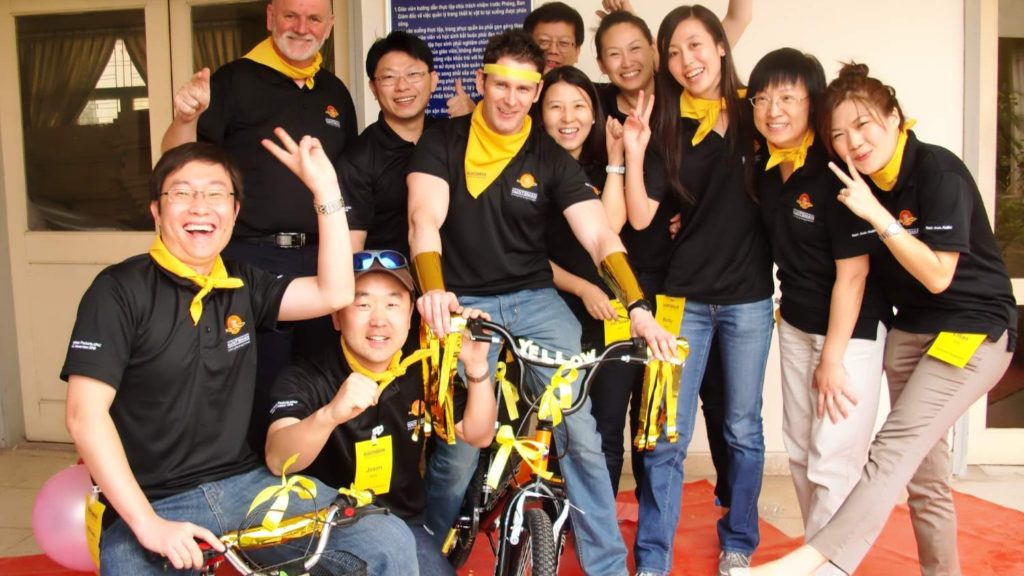
Giving back creates a particularly interesting environment for social identity because the team's objective extends beyond itself. Participants are not cooperating simply to win an activity. They are cooperating because their combined effort can produce something of value. The story therefore changes from: “I completed my part.” to: “We made this possible.” That distinction matters.
A completed object, contribution, or community outcome can serve as tangible evidence of collective action. Each person's contribution may be relatively small, but together those contributions create something that no individual participant would have produced alone.
That experience can reinforce one of the most valuable beliefs a team can possess: Together, we can make things happen. Psychology has a term closely related to this idea: collective efficacy. It describes a group's shared belief in its capability to organise and execute the actions necessary to achieve a particular outcome.
And there is substantial evidence connecting it with how groups perform. Alexander Stajkovic, Dongseop Lee and Anthony Nyberg conducted a major meta-analysis published in the Journal of Applied Psychology in 2009. Rather than examining a single company or a handful of teams, they synthesised evidence from 96 studies involving 6,128 groups and 31,019 individuals.
Their analysis found a significant positive relationship between collective efficacy and group performance, with a reported correlation of .35. But one finding is especially relevant to team building. The relationship became stronger as task interdependence increased. In simple terms, believing in the team's capability appears particularly important when people genuinely need one another to succeed.
That finding provides an important principle for designing team experiences. A group of people completing separate tasks in the same room is not necessarily collaborating.
Strong team experiences create interdependence: situations in which people must exchange information, combine resources, coordinate actions, and adapt to one another. Giving back can provide a particularly compelling reason for that interdependence. There is something worth achieving together.
Most workplace collaboration is instrumental. People cooperate because something has to be delivered: a project, a target, a deadline, or a customer outcome. Giving back changes the context. The immediate objective exists outside normal organisational performance.
For a short period, participants can step away from job titles, departmental targets, and hierarchies to concentrate on a shared goal. This can reveal people differently.
A senior executive may need help from a graduate recruit. Someone normally quiet in meetings may have exactly the practical idea the team needs. A colleague known for technical expertise may reveal an unexpected ability to organise, create or encourage others.
These interactions matter because our perceptions of colleagues are shaped partly by the contexts in which we repeatedly encounter them. Change the context, and people have an opportunity to see one another differently.
The evidence around social identification provides another reason to think seriously about belonging. The meta-analysis by Steffens and colleagues examined two decades of research into identification and health within organisations. Among those 19,799 participants, the researchers found a positive association between social identification and health, including identification with immediate work groups. This reinforces the idea that belonging is more than a nice-to-have and helps explain why team building should aim beyond communication alone.
This does not mean that simply putting people into teams improves wellbeing. People's sense of belonging to groups with which they genuinely identify can become meaningful psychological and social resources.
A team can provide a sense of belonging, support, a shared identity, and the belief that challenges do not always have to be faced alone. This helps explain why team building should ultimately focus on more than just improving communication techniques. It should also consider the social bonds through which cooperation becomes possible.
This distinction is particularly important in corporate social responsibility. Giving money can create considerable social impact. But psychologically, that differs greatly from inviting people to participate in creating the impact. When employees plan, solve, build, create and contribute together, CSR becomes an experience rather than simply an organisational statement. People move from being observers of a company's values to participants in them. That matters because organisational values ultimately become meaningful through behaviour.
If an organisation says that community, responsibility, or positive impact matters, a well-designed giving-back experience provides an opportunity for employees to enact those ideas together. It turns: “This is something our organisation believes.” into: “This is something we did.” And potentially: “This is something people like us do.”That final shift is important because it connects an isolated experience with group identity.
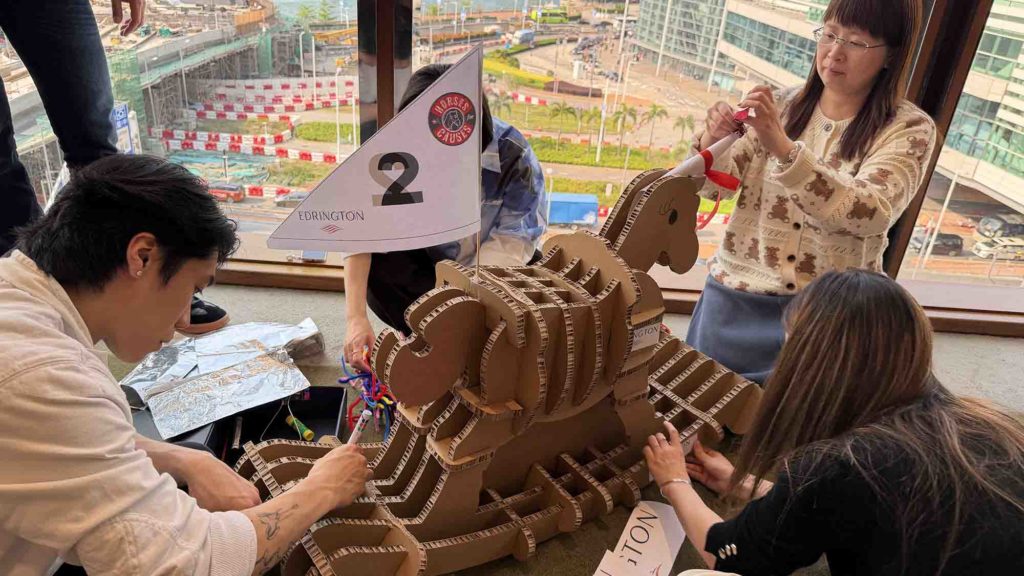
There is another important distinction to make. The value of a giving-back experience cannot be measured solely by how much is donated. From a team-development perspective, the quality of participation matters. Did people have choices? Did they need one another? Could they see how their contribution connected to the outcome? Was the beneficiary or purpose credible and understandable?
Did the experience allow different strengths to emerge? Could the team see what its collective effort had achieved? These questions help distinguish between participative and passive giving.
The aim is not to manufacture an emotional response. Organisations should not assume every employee will experience a charitable activity the same way. The aim is to create the conditions in which meaning, agency, interdependence and contribution can emerge naturally through the experience.
The research points towards an important conclusion. The charitable component alone does not create effective team building. The experience around it matters. Strong giving-back experiences should create genuine interdependence, help people understand how their contributions fit into the whole, and make the ultimate purpose clear. Participants should have agency rather than follow instructions. They should encounter problems worth solving. Different people should be able to contribute in different ways. There should be a visible connection between collective effort and outcome. This is where giving back and experiential team development intersect.
The strongest experiences tend to combine:
The objective is not simply to make people feel good. It is to create an experience in which cooperation produces meaningful consequences.
Giving back team building can take many forms. Some experiences involve teams creating useful items for communities. Others use creativity and problem-solving to support charitable or social causes. Technology-enabled experiences connect participants to broader challenges. Large-scale events can mobilise hundreds or thousands of people around a shared purpose.
Catalyst Global programmes, including Give Backpack, Building A Dream, Go Team – Go Give, Barkitecture, Hole in One and Horses for Causes, approach giving back in different ways. But the program itself is not the central idea. The underlying psychological process is more interesting. People contribute individually. They depend on one another collectively. Together, they create an outcome with a purpose beyond themselves.
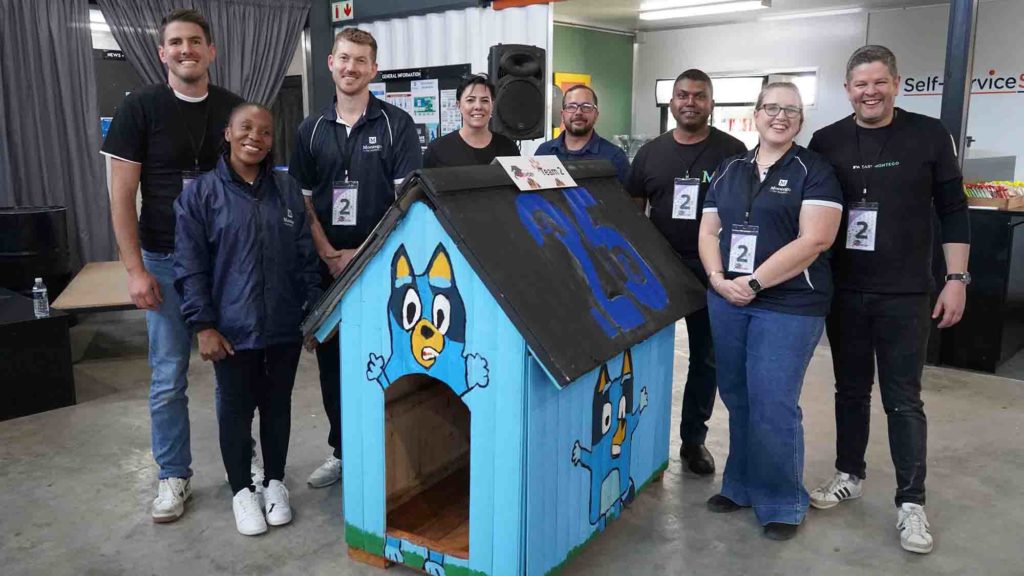
There is an important limit to recognise. One experience cannot transform organisational culture. It cannot create belonging in an organisation where people routinely feel excluded. An annual charity event cannot compensate for an organisational culture that fails to demonstrate the same values during the rest of the year.
Giving back team building should therefore be understood as an experience within a wider organisational system, rather than a solution in isolation. Its potential lies in giving people an opportunity to experience useful team dynamics directly. Helping. Shared achievement. Collective efficacy. Purpose. The organisational challenge is then to reinforce those behaviours when people return to everyday work.
This is the most interesting question. Not: “Did people enjoy the giving back activity?” But: “What happens afterwards?” If helping, sharing knowledge, supporting colleagues, and contributing beyond one's formal responsibilities are behaviours an organisation values, they need to recur in everyday working life. Leaders need to model them. Systems need to support them. Teams need to recognise them.
A giving-back experience can provide a vivid demonstration of those behaviours, but culture is created when they become the norm. At that point, giving back becomes more than a corporate social responsibility activity. It becomes one expression of: “How we do things here.”
The most interesting characteristic of giving-back team building is that its potential impact flows in two directions. Outwards, collective effort can contribute to a community, a charity, an environmental initiative, or a social cause. Inwards, the process gives people an opportunity to experience cooperation, interdependence, shared identity and collective achievement.
Research into human behaviour and teams helps explain why that combination deserves attention. Prosocial behaviour connects contribution with positive human experience.
Collective efficacy helps explain why experiencing success together can matter. Task interdependence reminds us that genuine collaboration requires people to need one another. And shared purpose gives that collaboration a reason beyond simply completing an exercise. The result is a very different philosophy of team building. It is not simply about bringing people together. It is about allowing them to discover what they can make possible together.
The ideas explored in this article draw on established research in social, organisational and positive psychology.
Dunn, E. W., Aknin, L. B. & Norton, M. I. (2008). Spending Money on Others Promotes Happiness. Science, 319(5870), 1687–1688. DOI: 10.1126/science.1150952
Aknin, L. B., Barrington-Leigh, C. P., Dunn, E. W., Helliwell, J. F., Burns, J., Biswas-Diener, R., Kemeza, I., Nyende, P., Ashton-James, C. E. & Norton, M. I. (2013). Prosocial Spending and Well-Being: Cross-Cultural Evidence for a Psychological Universal. Journal of Personality and Social Psychology, 104(4), 635–652.
DOI: 10.1037/a0031578
Stajkovic, A. D., Lee, D. & Nyberg, A. J. (2009). Collective Efficacy, Group Potency, and Group Performance: Meta-Analyses of Their Relationships, and Test of a Mediation Model. Journal of Applied Psychology, 94(3), 814–828. DOI: 10.1037/a0015659
Steffens, N. K., Haslam, S. A., Schuh, S. C., Jetten, J. & van Dick, R. (2017). A Meta-Analytic Review of Social Identification and Health in Organisational Contexts. Personality and Social Psychology Review
© 2026 All rights reserved.